Skip to content

Utilities

Utilities are sets of tools designed to support and streamline InSAR processing workflows.

Select Pairs

Select interferogram pairs from ASF search results based on temporal and perpendicular baseline criteria.

from insarhub import Downloader
from insarhub.utils import select_pairs

s1 = Downloader.create('S1_SLC',
                    intersectsWith=[-113.05, 37.74, -112.68, 38.00],
                    start='2020-01-01',
                    end='2020-12-31',
                    relativeOrbit=100,
                    frame=466,
                    workdir='path/to/dir')
results = s1.search()

pairs, baselines, scene_bperp, _ = select_pairs(search_results=results)

Parameters:

Name Type Description Default
search_results list[ASFProduct] | dict[tuple[int, int], list[ASFProduct]]

Either a flat list (single stack) or a dictionary keyed by (path, frame).

required
dt_targets list[float]

Preferred temporal spacings in days. A candidate pair passes if |dt - target| <= dt_tol for at least one target.

SELECT_PAIRS_DEFAULTS['dt_targets']
dt_tol float

Tolerance in days added to each entry in dt_targets.

SELECT_PAIRS_DEFAULTS['dt_tol']
dt_max float

Maximum temporal baseline in days.

SELECT_PAIRS_DEFAULTS['dt_max']
pb_max float

Maximum perpendicular baseline in meters.

SELECT_PAIRS_DEFAULTS['pb_max']
min_degree int

Minimum interferogram connections per scene. Enforced when force_connect is True.

SELECT_PAIRS_DEFAULTS['min_degree']
max_degree int

Maximum interferogram connections per scene.

SELECT_PAIRS_DEFAULTS['max_degree']
force_connect bool

If a scene falls below min_degree after primary selection, add its nearest-time neighbors that satisfy pb_max and dt_max. May introduce lower-quality pairs; a warning is logged.

SELECT_PAIRS_DEFAULTS['force_connect']
max_workers int

Number of threads for API fallback. Has no effect if all products have local baseline data (common for Sentinel-1 and ALOS). Set to 1 to disable threading (useful for debugging).

SELECT_PAIRS_DEFAULTS['max_workers']
aoi_wkt str

WKT geometry of the area of interest, recorded in the folder config so pair-quality scoring later reads back the same region. Defaults to None.

None
burst bool

Select pairs for an SLC-BURST stack. Nodes become YYYYMMDD acquisition dates; dt is computed from burst startTime and bperp from per-date orbit state vectors (no parent-SLC lookup). Defaults to False.

False
safe_dir str | Path | None

Burst mode only: directory of assembled .SAFE dirs whose annotation orbits are used for bperp (post-download, offline).

None
eof_dir str | Path | None

Burst mode only: directory of precise-orbit .EOF files used for bperp (post-download, offline).

None
poeorb_cache str | Path | None

Burst mode only: directory for POEORB downloads keyed by date + mission (online fallback).

None
Source code in src/insarhub/utils/tool.py
def select_pairs(
    search_results: Union[dict[tuple[int, int], list[ASFProduct]], list[ASFProduct]],
    dt_targets: tuple[int, ...]  = _SP["dt_targets"],
    dt_tol: int                  = _SP["dt_tol"],
    dt_max: int                  = _SP["dt_max"],
    pb_max: float                = _SP["pb_max"],
    min_degree: int              = _SP["min_degree"],
    max_degree: int              = _SP["max_degree"],
    force_connect: bool          = _SP["force_connect"],
    max_workers: int             = _SP["max_workers"],
    aoi_wkt: str | None = None,
    burst: bool = False,
    safe_dir: str | Path | None = None,
    eof_dir: str | Path | None = None,
    poeorb_cache: str | Path | None = None,
) -> Union[PairGroup, list[Pair]]:

    """
    Select interferogram pairs based on temporal and perpendicular baseline.

    This function selects interferogram pairs according to temporal spacing 
    and perpendicular baseline constraints, optionally enforcing connectivity 
    rules per scene.

    When ``burst=True`` the same selection runs on SLC-BURST products:
    nodes are acquisition dates (one date = one stitched SAFE), temporal
    baseline comes from each burst's ``startTime``, and perpendicular baseline
    is resolved per date from ``safe_dir`` (assembled ``.SAFE`` annotations),
    ``eof_dir`` (local precise orbits), or a POEORB download keyed by date +
    mission. No parent-SLC lookup is performed.

    Supported sensors:
    - Sentinel-1 (CALCULATED)  : stateVectors + ascendingNodeTime → local
    - ALOS / ERS / RADARSAT (PRE_CALCULATED) : insarBaseline scalar → local
    - Any product missing data : ref.stack() API call → fallback

    Args:
        search_results (list[ASFProduct] | dict[tuple[int,int], list[ASFProduct]]):
            Either a flat list (single stack) or a dictionary keyed by (path, frame).
        dt_targets (list[float], optional):
            Preferred temporal spacings in days. A candidate pair passes if 
            |dt - target| <= dt_tol for at least one target.
        dt_tol (float, optional):
            Tolerance in days added to each entry in dt_targets.
        dt_max (float, optional):
            Maximum temporal baseline in days.
        pb_max (float, optional):
            Maximum perpendicular baseline in meters.
        min_degree (int, optional):
            Minimum interferogram connections per scene. Enforced when force_connect is True.
        max_degree (int, optional):
            Maximum interferogram connections per scene.
        force_connect (bool, optional):
            If a scene falls below min_degree after primary selection, add its nearest-time 
            neighbors that satisfy pb_max and dt_max. May introduce lower-quality pairs; a warning is logged.
        max_workers (int, optional):
            Number of threads for API fallback. Has no effect if all products have local baseline
            data (common for Sentinel-1 and ALOS). Set to 1 to disable threading (useful for debugging).
        aoi_wkt (str, optional):
            WKT geometry of the area of interest, recorded in the folder config
            so pair-quality scoring later reads back the same region.
            Defaults to None.
        burst (bool, optional):
            Select pairs for an SLC-BURST stack. Nodes become ``YYYYMMDD``
            acquisition dates; dt is computed from burst ``startTime`` and
            bperp from per-date orbit state vectors (no parent-SLC lookup).
            Defaults to False.
        safe_dir (str | Path | None, optional):
            Burst mode only: directory of assembled ``.SAFE`` dirs whose
            annotation orbits are used for bperp (post-download, offline).
        eof_dir (str | Path | None, optional):
            Burst mode only: directory of precise-orbit ``.EOF`` files used
            for bperp (post-download, offline).
        poeorb_cache (str | Path | None, optional):
            Burst mode only: directory for POEORB downloads keyed by date +
            mission (online fallback).

    Returns:
        tuple of three elements:

        pairs (list[Pair] | dict[tuple[int,int], list[Pair]]):
            A flat list of Pair tuples ``(earlier_scene, later_scene)`` if
            *search_results* was a list, or a dict keyed by ``(path, frame)``
            with lists of Pair tuples if *search_results* was a dict.

        baselines (BaselineTable | dict[tuple[int,int], BaselineTable]):
            Pairwise baseline table mapping ``(scene_a, scene_b)`` →
            ``(dt_days, bperp_m)`` where ``bperp_m = |bp_a − bp_b|`` (always
            positive). Mirrors the structure of *pairs* (flat or grouped).

        scene_bperp (dict[str, float] | dict[tuple[int,int], dict[str, float]]):
            Signed perpendicular baseline for each scene relative to the
            anchor (earliest) scene, as returned by
            ``calculate_perpendicular_baselines``. Values can be negative or
            positive. Use this for network plots to reproduce the MintPy-style
            y-axis (negative/positive spread around zero). Mirrors the
            structure of *pairs* (flat or grouped).
    """

    # ── normalise input ───────────────────────────────────────────────────
    input_is_list = isinstance(search_results, list)
    if input_is_list:
        working_dict: dict[tuple[int, int], list[ASFProduct]] = {
            (0, 0): search_results   # type: ignore[arg-type]
        }
    elif isinstance(search_results, dict):
        working_dict = search_results
    else:
        raise TypeError(
            f"search_results must be a list or dict of ASFProducts, "
            f"got {type(search_results)}"
        )

    # ── primary filter helpers (defined once, closed over threshold args) ─
    def _near_target(dt: float) -> bool:
        return any(abs(dt - t) <= dt_tol for t in dt_targets)

    def _passes_primary(dt: float, bp: float) -> bool:
        return _near_target(dt) and dt <= dt_max and bp <= pb_max

    pairs_group: PairGroup = defaultdict(list)
    baseline_group: dict[tuple[int, int], BaselineTable] = {}
    scene_bperp_group: dict[tuple[int, int], dict] = {}

    # ── process each (path, frame) key ───────────────────────────────────
    for key, search_result in working_dict.items():
        if not input_is_list:
            label = key[1] if not burst else key[1]
            logger.info(
                "%sSearching pairs for path %d frame %s …",
                Fore.GREEN, key[0], label,
            )

        if burst:
            # ── burst path: one node per acquisition date ──────────────────
            # ASF publishes no baseline metadata for SLC-BURST products, so
            # every burst inherits the geometry of the date it was acquired
            # on. Nodes are dates, dt comes from startTime, bperp from the
            # per-date orbit (SAFE annotation / local EOF / POEORB by date).
            dates, id_time_dt, B, scene_bp = _select_burst_group(
                search_result,
                safe_dir=safe_dir, eof_dir=eof_dir, poeorb_cache=poeorb_cache,
            )
            names = dates
        else:
            # Sort by acquisition time so `names` is chronologically ordered
            prods = sorted(search_result, key=lambda p: p.properties["startTime"])

            if not prods:
                logger.warning("No products for key %s — skipping.", key)
                continue

            # Collapse same-calendar-date products (e.g. multiple frames of one
            # track/orbital pass, most commonly a merge group spanning several
            # ASF frame numbers) into a single representative product per date —
            # mirrors ISCE2 stackSentinel's own sentinelSLC.get_dates() merge
            # behavior, so temporal/baseline network connectivity (min_degree /
            # max_degree) is computed per acquisition date, not per physical
            # frame file. A no-op for the normal single-frame case, where a key
            # never has two products sharing a date.
            prods, n_collapsed = _collapse_by_date(prods)
            if n_collapsed:
                logger.info(
                    "%s: collapsed %d same-date product(s) across frames "
                    "(%d unique acquisition date(s)).",
                    key, n_collapsed, len(prods),
                )

            # Pre-parse acquisition datetimes to Unix timestamps (done once;
            # reused in sort keys, dt calculations, and pair ordering)
            id_time_raw: dict[SceneID, str] = {
                p.properties["sceneName"]: p.properties["startTime"] for p in prods
            }
            id_time_dt: dict[SceneID, DateFloat] = {
                sid: isoparse(t).timestamp() for sid, t in id_time_raw.items()
            }
            ids: set[SceneID] = set(id_time_raw)
            names: list[SceneID] = [p.properties["sceneName"] for p in prods]

            # ── 1. Build pairwise baseline table ─────────────────────────
            B, scene_bp = _build_baseline_table(prods, ids, id_time_dt, max_workers=max_workers)

        baseline_group[key] = B
        scene_bperp_group[key] = scene_bp
        # ── 2. Primary pair selection ─────────────────────────────────────
        pairs: set[Pair] = {
            e for e, (dt, bp) in B.items() if _passes_primary(dt, bp)
        }
        logger.info(
            "Key %s — primary selection: %d / %d candidate pairs.",
            key, len(pairs), len(B),
        )

        # ── 3. Connectivity enforcement ───────────────────────────────────
        pairs = _enforce_connectivity(
            pairs,
            B,
            names,
            id_time_dt,
            min_degree=min_degree,
            max_degree=max_degree,
            pb_max=pb_max,
            dt_max=float(dt_max),
            force_connect=force_connect
        )

        pairs_group[key] = sorted(pairs)
        logger.info(
            "Key %s — final pair count: %d.", key, len(pairs_group[key])
        )
    pairs = pairs_group[(0, 0)] if input_is_list else pairs_group
    scene_bperp = scene_bperp_group.get((0, 0), {}) if input_is_list else scene_bperp_group

    return pairs, baseline_group, scene_bperp

Plot Pair Network

Plot the SBAS interferogram network returned by select_pairs.

from insarhub.utils import plot_pair_network

fig = plot_pair_network(pairs=pairs, baselines=baselines, scene_baselines=scene_bperp)
fig.show()

Example:
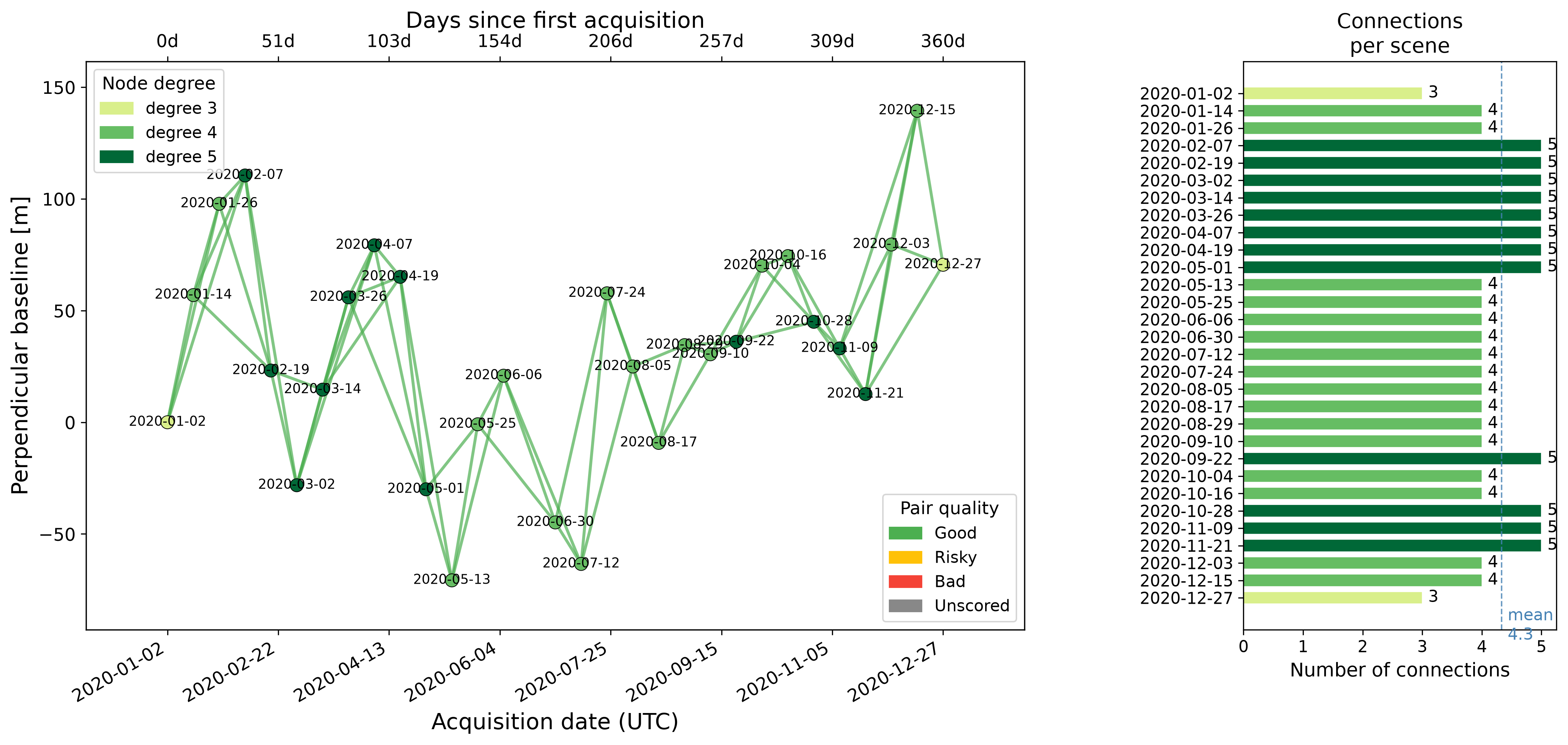
networks

Parameters:

Name Type Description Default
pairs list[Pair] | PairGroup

A flat list of pairs or a dictionary keyed by (path, frame) with lists of pairs. Each pair is a tuple (earlier_scene, later_scene).

required
baselines BaselineTable

Table or mapping containing temporal and perpendicular baseline information for each interferogram pair.

required
title str

Main title of the network plot. Defaults to "Interferogram Network".

'Interferogram Network'
figsize tuple[int, int]

Figure size (width, height) in inches. Defaults to (18, 7).

(18, 7)
save_path str | Path | None

Path to save the generated figure. If None, figure is not saved. Defaults to None.

None

Raises:

Type Description
TypeError

If any scene name in pairs is not a string.

ValueError

If a scene name cannot be parsed into a valid date.

Source code in src/insarhub/utils/tool.py
1524
1525
1526
1527
1528
1529
1530
1531
1532
1533
1534
1535
1536
1537
1538
1539
1540
1541
1542
1543
1544
1545
1546
1547
1548
1549
1550
1551
1552
1553
1554
1555
1556
1557
1558
1559
1560
1561
1562
1563
1564
1565
1566
1567
1568
1569
1570
1571
1572
1573
1574
1575
1576
1577
1578
1579
1580
1581
1582
1583
1584
1585
1586
1587
1588
1589
1590
1591
1592
1593
1594
1595
1596
1597
1598
1599
1600
1601
1602
1603
1604
1605
1606
1607
1608
1609
1610
1611
1612
1613
1614
1615
1616
1617
1618
1619
1620
1621
1622
1623
1624
1625
1626
1627
1628
1629
1630
1631
1632
1633
1634
1635
1636
1637
1638
1639
1640
1641
1642
1643
1644
1645
1646
1647
1648
1649
1650
1651
1652
1653
1654
1655
1656
1657
1658
1659
1660
1661
1662
1663
1664
1665
1666
1667
1668
1669
1670
1671
1672
1673
1674
1675
1676
1677
1678
1679
1680
1681
1682
1683
1684
1685
1686
1687
1688
1689
1690
1691
1692
1693
1694
1695
1696
1697
1698
1699
1700
1701
1702
1703
1704
1705
1706
1707
1708
1709
1710
1711
1712
1713
1714
1715
1716
1717
1718
1719
1720
1721
1722
1723
1724
1725
1726
1727
1728
1729
1730
1731
1732
1733
1734
1735
1736
1737
1738
1739
1740
1741
1742
1743
1744
1745
1746
1747
1748
1749
1750
1751
1752
1753
1754
1755
1756
1757
1758
1759
1760
1761
1762
1763
1764
1765
1766
1767
1768
1769
1770
1771
1772
1773
1774
1775
1776
1777
1778
1779
1780
1781
1782
1783
1784
1785
1786
1787
1788
1789
1790
1791
1792
1793
1794
1795
1796
1797
1798
1799
1800
1801
1802
1803
1804
1805
1806
1807
1808
1809
1810
1811
1812
1813
1814
1815
1816
1817
1818
1819
1820
1821
1822
1823
1824
1825
1826
1827
1828
1829
1830
1831
1832
1833
1834
1835
1836
1837
1838
1839
1840
1841
1842
1843
1844
1845
1846
1847
1848
1849
1850
1851
1852
1853
1854
1855
1856
1857
1858
1859
1860
1861
1862
1863
1864
1865
1866
1867
1868
1869
1870
1871
1872
1873
1874
1875
1876
1877
1878
1879
1880
1881
1882
1883
1884
1885
1886
1887
1888
1889
1890
1891
1892
1893
1894
1895
1896
1897
1898
1899
1900
1901
1902
1903
1904
1905
1906
1907
1908
1909
1910
1911
1912
1913
1914
1915
1916
1917
1918
1919
1920
def plot_pair_network(
    pairs: list[Pair] | PairGroup,
    baselines: BaselineTable,
    scene_baselines: dict | None = None,
    title: str = "Interferogram Network",
    figsize: tuple[int, int] = (18, 7),
    save_path: str | Path | None = None,
    pair_status: dict[str, str] | None = None,
    quality_factors: dict[str, dict] | None = None,
) -> plt.Figure | dict:

    """
    Plot an interferogram network along with per-scene connection statistics.

    This function visualizes the relationships between SAR acquisitions in
    terms of temporal and perpendicular baselines. The network graph is
    shown on the left, while a horizontal bar chart summarizes the number
    of connections per scene on the right.

    The layout is as follows:
        - Left  : Network graph (x-axis = days since first acquisition,
                  y-axis = perpendicular baseline [m])
        - Right : Horizontal bar chart showing the number of connections per SAR scene

    Args:
        pairs (list[Pair] | PairGroup):
            A flat list of pairs or a dictionary keyed by (path, frame)
            with lists of pairs. Each pair is a tuple `(earlier_scene, later_scene)`.
        baselines (BaselineTable):
            Table or mapping containing temporal and perpendicular baseline
            information for each interferogram pair.
        title (str, optional):
            Main title of the network plot. Defaults to "Interferogram Network".
        figsize (tuple[int, int], optional):
            Figure size (width, height) in inches. Defaults to (18, 7).
        save_path (str | Path | None, optional):
            Path to save the generated figure. If None, figure is not saved.
            Defaults to None.

    Returns:
        matplotlib.figure.Figure:
            The created matplotlib figure containing the network and
            per-scene connection histogram.

    Raises:
        TypeError:
            If any scene name in `pairs` is not a string.
        ValueError:
            If a scene name cannot be parsed into a valid date.

    Notes:
        - Node positions: x = days since first acquisition, y = perpendicular baseline.
        - Node color represents the node degree (number of connections).
        - Edge color and width represent temporal baseline.
        - Scenes with fewer than 2 connections are highlighted in red in the histogram.
        - Legends show node degree, temporal baseline, and path/frame grouping.
        - The top axis of the network plot shows real acquisition dates for reference.
    """
    import networkx as nx

    # ── 0. Normalise input ────────────────────────────────────────────────

    if isinstance(pairs, dict):
        figures = {}

        save_path_obj = None
        save_is_dir = False

        if save_path is not None:
            save_path_obj = Path(save_path).expanduser()

            if save_path_obj.suffix == "":
                save_is_dir = True
                save_path_obj.mkdir(parents=True, exist_ok=True)
            else:
                # Has suffix → treat as file template
                save_path_obj.parent.mkdir(parents=True, exist_ok=True)

        for (path, frame), group_pairs in pairs.items():
            group_title = f"{title} — P{path}/F{frame}"
            group_save_path = None

            if save_path_obj is not None:
                if save_is_dir:
                    # Case 1: directory given
                    group_save_path = (
                        save_path_obj.joinpath(f"network_P{path}_F{frame}.png")
                    )
                else:
                    # Case 2: file with suffix given
                    group_save_path = (
                        save_path_obj.parent
                        / f"{save_path_obj.stem}_P{path}_F{frame}{save_path_obj.suffix}"
                    )

            fig = plot_pair_network(
                    pairs=group_pairs,
                    baselines=baselines[(path, frame)],
                    scene_baselines=scene_baselines.get((path, frame)) if isinstance(scene_baselines, dict) else scene_baselines,
                    title=group_title,
                    figsize=figsize,
                    save_path=group_save_path,
                    pair_status=pair_status,
                    quality_factors=quality_factors,
                )

            figures[(path, frame)] = fig

        return figures


    flat_pairs = pairs
    subtitle = f"{len(flat_pairs)} pairs"
    if save_path is not None:
        save_path = Path(save_path).expanduser()
    # ── 1. Parse dates ────────────────────────────────────────────────────
    scenes: set[SceneID] = set()
    for a, b in flat_pairs:
        scenes.update([a, b])

    def _parse_date(scene_name: str) -> datetime:
        if not isinstance(scene_name, str):
            raise TypeError(
                f"Expected str, got {type(scene_name).__name__}: {scene_name!r}."
            )
        m = re.search(r"(\d{8})", scene_name)
        if m:
            return datetime.strptime(m.group(1), "%Y%m%d")
        m = re.search(r"(\d{4}-\d{2}-\d{2})", scene_name)
        if m:
            return datetime.strptime(m.group(1), "%Y-%m-%d")
        raise ValueError(f"Cannot parse date from scene name: {scene_name}")

    id_time: dict[SceneID, datetime] = {s: _parse_date(s) for s in scenes}
    t0      = min(id_time.values())
    id_days: dict[SceneID, float] = {
        s: (id_time[s] - t0).total_seconds() / 86_400.0 for s in scenes
    }

    # ── 2. Build graph ────────────────────────────────────────────────────
    G = nx.Graph()
    G.add_nodes_from(scenes)

    if isinstance(pairs, dict):
        for (path, frame), pair_list in pairs.items():
            for a, b in pair_list:
                dt, bp = baselines.get((a, b), (_MISSING, _MISSING))
                G.add_edge(a, b, dt=dt, bp=bp, path=path, frame=frame)
    else:
        for a, b in flat_pairs:
            dt, bp = baselines.get((a, b), (_MISSING, _MISSING))
            G.add_edge(a, b, dt=dt, bp=bp, path=0, frame=0)

    # ── 3. Node positions (x=days, y=bperp) ──────────────────────────────
    if scene_baselines:
        # Use signed per-scene bperp relative to anchor — same as MintPy display
        # (negative = scene orbited closer than anchor, positive = further)
        bperp_pos: dict[SceneID, float] = {
            s: float(scene_baselines.get(s, 0.0)) for s in scenes
        }
    else:
        # Fallback: reconstruct from pairwise table (loses sign info, may trend upward)
        bperp_accum: dict[SceneID, list[float]] = defaultdict(list)
        for (a, b), (dt, bp) in baselines.items():
            if bp >= _MISSING:
                continue
            bperp_accum[a].append(-bp / 2.0)
            bperp_accum[b].append(+bp / 2.0)
        bperp_pos = {
            s: float(np.mean(v)) if v else 0.0
            for s, v in bperp_accum.items()
        }
        sorted_by_time = sorted(scenes, key=lambda s: id_days[s])
        offset = bperp_pos.get(sorted_by_time[0], 0.0)
        bperp_pos = {s: bperp_pos.get(s, 0.0) - offset for s in scenes}

    pos: dict[SceneID, tuple[float, float]] = {
        s: (id_days[s], bperp_pos[s]) for s in scenes
    }

    # ── 4. Visual attributes ──────────────────────────────────────────────
    # Two states, matching the GUI. A pair is flagged concern when at least one
    # serious extreme condition was detected at either acquisition — see
    # insarhub.utils.pair_quality._events. There is no "bad": the events are
    # environmental proxies and cannot support a claim that data is unusable.
    _Q_HEALTHY = '#4caf50'
    _Q_CONCERN   = '#ffc107'
    _Q_NONE    = '#888888'   # not judged

    def _status_colour(st: str | None) -> str:
        if st == "concern":
            return _Q_CONCERN
        if st == "healthy":
            return _Q_HEALTHY
        return _Q_NONE

    degrees      = dict(G.degree())
    max_deg      = max(degrees.values(), default=1)
    node_colours = [plt.cm.RdYlGn(degrees[n] / max_deg) for n in G.nodes()]

    edge_dts     = [G[a][b]["dt"] for a, b in G.edges()]
    max_dt       = max((d for d in edge_dts if d < _MISSING), default=1.0)

    if pair_status:
        edge_colours = []
        edge_widths  = []
        for a, b in G.edges():
            st = pair_status.get(f"{a}:{b}") or pair_status.get(f"{b}:{a}")
            edge_colours.append(_status_colour(st))
            edge_widths.append(2.0 if st == "healthy" else
                               1.0 if st == "concern" else 0.7)
    else:
        edge_colours = [plt.cm.RdYlGn_r(min(dt, max_dt) / max_dt) for dt in edge_dts]
        edge_widths  = [0.5 + 2.5 * (1.0 - min(dt, max_dt) / max_dt) for dt in edge_dts]

    if isinstance(pairs, dict):
        group_keys  = list(pairs.keys())
        linestyles  = ["-", "--", "-.", ":"] * (len(group_keys) // 4 + 1)
        key_style   = {k: linestyles[i] for i, k in enumerate(group_keys)}
        edge_styles = [
            key_style[(G[a][b]["path"], G[a][b]["frame"])] for a, b in G.edges()
        ]
    else:
        edge_styles = ["-"] * len(G.edges())

    # ── 5. Figure layout ─────────────────────────────────────────────────
    # Main figure: network + histogram.
    # Per-class figures are saved separately when class data is available.
    fig = plt.figure(figsize=figsize)
    gs  = fig.add_gridspec(1, 2, width_ratios=[3, 1], wspace=0.35)
    ax_net  = fig.add_subplot(gs[0])
    ax_hist = fig.add_subplot(gs[1])

    # ── 6. Draw network ───────────────────────────────────────────────────
    edges_by_style: dict[str, list] = defaultdict(list)
    for (a, b), style, colour, width in zip(
        G.edges(), edge_styles, edge_colours, edge_widths
    ):
        edges_by_style[style].append((a, b, colour, width))

    for style, edge_data in edges_by_style.items():
        nx.draw_networkx_edges(
            G, pos, ax=ax_net,
            edgelist=[(a, b) for a, b, _, _ in edge_data],
            edge_color=[c for _, _, c, _ in edge_data],
            width=[w for _, _, _, w in edge_data],
            style=style,
            alpha=0.7,
        )

    nx.draw_networkx_nodes(
        G, pos, ax=ax_net,
        node_color=node_colours,
        node_size=80,
        linewidths=0.5,
        edgecolors="black",
    )
    nx.draw_networkx_labels(
        G, pos,
        labels={s: id_time[s].strftime("%Y-%m-%d") for s in G.nodes()},
        ax=ax_net,
        font_size=9,
    )

    # ── 7. Network axes ───────────────────────────────────────────────────
    ax_net.set_xlabel("Acquisition date (UTC)", fontsize=15)
    ax_net.set_ylabel("Perpendicular baseline [m]", fontsize=15)
    ax_net.set_title("")
    ax_net.tick_params(left=True, bottom=True, labelleft=True, labelbottom=True, labelsize=12)
    ax_net.set_frame_on(True)

    # bottom axis: real acquisition dates
    x_vals  = [p[0] for p in pos.values()]
    x_ticks = np.linspace(min(x_vals), max(x_vals), min(8, len(pos)))
    ax_net.set_xticks(x_ticks)
    ax_net.set_xticklabels(
        [
            (t0 + __import__("datetime").timedelta(days=d)).strftime("%Y-%m-%d")
            for d in x_ticks
        ],
        rotation=30, ha="right", fontsize=12,
    )

    # top axis: days since first acquisition
    ax2 = ax_net.twiny()
    ax2.set_xlim(ax_net.get_xlim())
    ax2.set_xticks(x_ticks)
    ax2.set_xticklabels(
        [f"{int(round(d))}d" for d in x_ticks],
        rotation=0, ha="center", fontsize=12,
    )
    ax2.set_xlabel("Days since first acquisition", fontsize=15)

    # ── 8. Per-scene connection histogram ─────────────────────────────────
    # Sort scenes by date so the histogram reads chronologically top→bottom
    sorted_scene_names = sorted(scenes, key=lambda s: id_days[s])
    scene_degrees      = [degrees[s] for s in sorted_scene_names]
    date_labels        = [id_time[s].strftime("%Y-%m-%d") for s in sorted_scene_names]
    y_positions        = range(len(sorted_scene_names))

    bar_colours = [plt.cm.RdYlGn(degrees[s] / max_deg) for s in sorted_scene_names]

    bars = ax_hist.barh(
        y_positions,
        scene_degrees,
        color=bar_colours,
        edgecolor="white",
        linewidth=0.4,
        height=0.7,
    )

    # annotate each bar with connection count
    for bar, count in zip(bars, scene_degrees):
        ax_hist.text(
            bar.get_width() + 0.1,
            bar.get_y() + bar.get_height() / 2,
            str(count),
            va="center", fontsize=11,
        )

    # vertical line at mean degree
    mean_deg = np.mean(scene_degrees)
    ax_hist.axvline(
        mean_deg, color="steelblue", linestyle="--", linewidth=1.0, alpha=0.8
    )
    ax_hist.text(
        mean_deg + 0.1, len(sorted_scene_names) - 0.5,
        f"mean\n{mean_deg:.1f}",
        color="steelblue", fontsize=11, va="top",
    )

    # mark scenes below min connectivity in red
    for i, (s, deg) in enumerate(zip(sorted_scene_names, scene_degrees)):
        if deg < 2:
            ax_hist.get_children()[i].set_edgecolor("red")
            ax_hist.get_children()[i].set_linewidth(1.5)

    ax_hist.set_yticks(y_positions)
    ax_hist.set_yticklabels(date_labels, fontsize=11)
    ax_hist.set_xlabel("Number of connections", fontsize=13)
    ax_hist.set_title("Connections\nper scene", fontsize=14)
    ax_hist.xaxis.set_major_locator(plt.MaxNLocator(integer=True))
    ax_hist.tick_params(axis="x", labelsize=11)
    ax_hist.set_frame_on(True)
    # match vertical order to network: earliest at top
    ax_hist.invert_yaxis()

    # ── 9. Legends ────────────────────────────────────────────────────────
    deg_legend = ax_net.legend(
        handles=[
            mpatches.Patch(color=plt.cm.RdYlGn(v / max_deg), label=f"degree {v}")
            for v in sorted(set(degrees.values()))
        ],
        title="Node degree", loc="upper left", fontsize=11, title_fontsize=12,
    )
    ax_net.add_artist(deg_legend)

    if pair_status:
        ax_net.legend(
            handles=[
                mpatches.Patch(color=_Q_HEALTHY, label="Healthy"),
                mpatches.Patch(color=_Q_CONCERN,   label="Concern"),
                mpatches.Patch(color=_Q_NONE,    label="Not judged"),
            ],
            title="Pair quality", loc="lower right", fontsize=11, title_fontsize=12,
        )
    else:
        ax_net.legend(
            handles=[
                mpatches.Patch(
                    color=plt.cm.RdYlGn_r(v / max_dt), label=f"{v:.0f} days"
                )
                for v in [0, max_dt * 0.33, max_dt * 0.66, max_dt]
            ],
            title="Temporal baseline", loc="lower right", fontsize=11, title_fontsize=12,
        )

    if isinstance(pairs, dict):
        ax_net.add_artist(
            ax_net.legend(
                handles=[
                    mpatches.Patch(
                        linestyle=key_style[k], fill=False,
                        edgecolor="grey", label=f"P{k[0]}/F{k[1]}",
                    )
                    for k in group_keys
                ],
                title="Path / Frame", loc="upper right", fontsize=11, title_fontsize=12,
            )
        )

    if save_path:
        fig.savefig(save_path.as_posix(), dpi=300, bbox_inches="tight")
        print(f"Saved → {save_path}")

    return fig

ERA5 Downloader

Download ERA5 pressure-level weather data for MintPy tropospheric correction. Automatically determines required acquisition dates and spatial extents from HyP3 zip files and saves files using MintPy-compatible naming (ERA5_S*_N*_W*_E*_YYYYMMDD_HH.grb). Requires a ~/.cdsapirc file with your CDS API credentials.

from insarhub.utils import ERA5Downloader

era5 = ERA5Downloader(output_dir='path/to/era5', num_processes=3, max_retries=3)
era5.download_batch(batch_dir='path/to/hyp3/outputs')

Parameters:

Name Type Description Default
output_dir str

Directory to save ERA5 .grb files. Created if it does not exist. Defaults to None.

None
num_processes int

Number of parallel download workers. Defaults to 3.

3
max_retries int

Retry attempts per file on download failure. Defaults to 3.

3
Source code in src/insarhub/utils/batch.py
class ERA5Downloader:
    """A class to handle batch downloading of ERA5 weather data for InSAR processing,
    formatted specifically for MintPy compatibility.

    Args:
        output_dir (str, optional): Directory to save ERA5 `.grb` files. Created if it does not exist. Defaults to None.
        num_processes (int, optional): Number of parallel download workers. Defaults to 3.
        max_retries (int, optional): Retry attempts per file on download failure. Defaults to 3.
    """

    PRESSURE_LEVELS = [
        '1', '2', '3', '5', '7', '10', '20', '30', '50', '70', '100', '125', '150', 
        '175', '200', '225', '250', '300', '350', '400', '450', '500', '550', '600', 
        '650', '700', '750', '775', '800', '825', '850', '875', '900', '925', '950', 
        '975', '1000'
    ]

    def __init__(self, output_dir=None, num_processes=3, max_retries=3):
        self.output_dir = Path(output_dir).expanduser().resolve() if output_dir else None
        if self.output_dir:
            self.output_dir.mkdir(parents=True, exist_ok=True)
        self.num_processes = num_processes
        self.max_retries = max_retries

        # Internal client holder for workers
        self._worker_client = None

    @staticmethod
    def _get_round_hour(time_str):
        """Rounds HHMMSS to the nearest whole hour."""
        h = int(time_str[0:2])
        m = int(time_str[2:4])
        s = int(time_str[4:6])

        if m > 30 or (m == 30 and s > 0):
            h += 1
        if h == 24:
            h = 0
        return f"{h:02d}"

    @staticmethod
    def _calculate_snwe(snwe, min_buffer=2, step=10):
        """Calculates buffered bounding box in multiples of 'step'."""
        def ceil2multiple(x, s):
            return x if x % s == 0 else x + (s - x % s)

        def floor2multiple(x, s):
            return x - x % s

        s_orig, n_orig, w_orig, e_orig = snwe
        S = np.floor(min(s_orig, n_orig) - min_buffer)
        N = np.ceil(max(s_orig, n_orig) + min_buffer)
        W = np.floor(min(w_orig, e_orig) - min_buffer)
        E = np.ceil(max(w_orig, e_orig) + min_buffer)

        if step > 1:
            S, W = floor2multiple(S, step), floor2multiple(W, step)
            N, E = ceil2multiple(N, step), ceil2multiple(E, step)

        return (int(S), int(N), int(W), int(E))

    @staticmethod
    def _get_mintpy_filename(output_dir, day, hr, snwe):
        """Generates MintPy-compliant filename: ERA5_S10_N20_W120_E110_YYYYMMDD_HH.grb"""
        s, n, w, e = snwe
        def fmt(val):
            return f"{'S' if val < 0 else 'N'}{abs(val)}" if val == s or val == n \
                   else f"{'W' if val < 0 else 'E'}{abs(val)}"

        # Note: MintPy logic often uses N/S for lat and W/E for lon
        area_str = f"_{fmt(s)}_{fmt(n)}_{fmt(w)}_{fmt(e)}"
        return Path(output_dir) / f"ERA5{area_str}_{day}_{hr}.grb"

    def _prepare_cds_payload(self, day, hr, snwe_tuple):
        """Formats the dictionary for the CDS API request."""
        S, N, W, E = snwe_tuple
        return {
            'product_type': ['reanalysis'],
            'variable': ['geopotential', 'temperature', 'specific_humidity'],
            'year': [day[0:4]],
            'month': [day[4:6]],
            'day': [day[6:8]],
            'time': [f'{hr}:00'],
            'pressure_level': self.PRESSURE_LEVELS,
            'data_format': 'grib',
            'area': [N, W, S, E],  # CDS format: North, West, South, East
        }

    @classmethod
    def _worker_init(cls):
        """Initializer for multiprocessing pool to create a per-process CDS client."""
        global _client
        _client = cdsapi.Client(progress=False, quiet=True)
        logger = logging.getLogger('cdsapi')
        logger.setLevel(logging.WARNING)

    @staticmethod
    def _download_worker(task_info):
        """The actual download function executed by the worker process."""
        global _client
        dataset = task_info['dataset']
        dest_path = task_info['dest_path']
        max_retries = task_info['max_retries']

        for attempt in range(1, max_retries + 1):
            try:
                result = _client.retrieve('reanalysis-era5-pressure-levels', dataset)
                result.download(dest_path)
                return Path(dest_path).name
            except Exception as e:
                if attempt == max_retries:
                    return f"ERROR: {dest_path} failed after {max_retries} attempts: {str(e)}"
                time.sleep(min(60, 5 * attempt))

    def download_batch(self, batch_dir):
        """Scan a directory of HyP3 zip files, determine required ERA5 dates and extents, and download missing files.

        Already-downloaded files are skipped automatically, so the method is safe to re-run after an interrupted download.

        Args:
            batch_dir (str): Directory containing HyP3 `.zip` files. Subdirectories are scanned if no zips are found directly.

        Raises:
            ValueError: If no valid geometry can be extracted from any zip file in the batch directory.
        """
        batch_path = Path(batch_dir).expanduser().resolve()

        # If zips are in batch_dir or its hyp3/ subdir, treat it as a single group
        _hyp3_sub = Hyp3Paths(batch_path).output_dir
        direct_zips = list(_hyp3_sub.glob('*.zip')) if _hyp3_sub.is_dir() else list(batch_path.glob('*.zip'))
        folders_to_scan = [batch_path] if direct_zips else [
            s for s in batch_path.iterdir() if s.is_dir()
        ]

        for subfolder in tqdm(folders_to_scan, desc="Folders", position=0):
            _sub_hyp3 = Hyp3Paths(subfolder).output_dir
            zip_files = list(_sub_hyp3.glob('*.zip')) if _sub_hyp3.is_dir() else list(subfolder.glob('*.zip'))
            if not zip_files:
                continue

            W, E, N, S = 180, -180, -90, 90
            dates = set()
            valid_files_count = 0

            # 1. Scan Metadata from Zips
            for zip_path in tqdm(zip_files, desc=f"Scanning {subfolder.name[:10]}...", leave=False, position=1):
                try:
                    with zipfile.ZipFile(zip_path, 'r') as z:
                        namelist = z.namelist()

                        # Extract Dates
                        date_match = re.findall(r'(\d{8})T(\d{6})', zip_path.name)
                        for d, t in date_match:
                            dates.add(f'{d}_{self._get_round_hour(t)}')

                        # Extract Spatial Bounds using GDAL Virtual File System
                        dem_file = next((f for f in namelist if '_dem.tif' in f or '_unw_phase.tif' in f), None)
                        if dem_file:
                            vsi_path = f"/vsizip/{zip_path.as_posix()}/{dem_file}"
                            with rasterio.open(vsi_path) as src:
                                l, b, r, t = src.bounds
                                wgs = transform_bounds(src.crs, 'EPSG:4326', l, b, r, t)
                                W, S, E, N = min(W, wgs[0]), min(S, wgs[1]), max(E, wgs[2]), max(N, wgs[3])
                                valid_files_count += 1
                except Exception:
                    continue

            if valid_files_count == 0:
                print(f"{Fore.RED}No geometry found in {subfolder.name}")
                continue

            # 2. Prepare Download Tasks
            snwe_tuple = self._calculate_snwe((S, N, W, E))
            era5_out = self.output_dir if self.output_dir else subfolder
            era5_out.mkdir(parents=True, exist_ok=True)
            tasks = []
            for date_str in sorted(dates):
                day, hr = date_str.split('_')
                output_path = self._get_mintpy_filename(era5_out, day, hr, snwe_tuple)

                if output_path.exists():
                    continue

                tasks.append({
                    'dataset': self._prepare_cds_payload(day, hr, snwe_tuple),
                    'dest_path': output_path.as_posix(),
                    'max_retries': self.max_retries
                })

            # 3. Execute Parallel Downloads
            if not tasks:
                print(f"{Fore.GREEN}All files exist for {subfolder.name}")
                continue

            tqdm.write(f"{Fore.CYAN}Downloading {len(tasks)} files for {subfolder.name}...")
            with multiprocessing.Pool(processes=self.num_processes, initializer=self._worker_init) as pool:
                with tqdm(total=len(tasks), desc="Progress", unit="file", leave=False) as pbar:
                    for result in pool.imap_unordered(self._download_worker, tasks):
                        if result.startswith("ERROR"):
                            pbar.write(f"{Fore.RED}{result}")
                        else:
                            pbar.set_postfix_str(f"Finished: {result}")
                        pbar.update(1)

        print(f"{Fore.MAGENTA}Batch Processing Complete.")
download_batch(batch_dir)

Parameters:

Name Type Description Default
batch_dir str

Directory containing HyP3 .zip files. Subdirectories are scanned if no zips are found directly.

required

Raises:

Type Description
ValueError

If no valid geometry can be extracted from any zip file in the batch directory.

Source code in src/insarhub/utils/batch.py
def download_batch(self, batch_dir):
    """Scan a directory of HyP3 zip files, determine required ERA5 dates and extents, and download missing files.

    Already-downloaded files are skipped automatically, so the method is safe to re-run after an interrupted download.

    Args:
        batch_dir (str): Directory containing HyP3 `.zip` files. Subdirectories are scanned if no zips are found directly.

    Raises:
        ValueError: If no valid geometry can be extracted from any zip file in the batch directory.
    """
    batch_path = Path(batch_dir).expanduser().resolve()

    # If zips are in batch_dir or its hyp3/ subdir, treat it as a single group
    _hyp3_sub = Hyp3Paths(batch_path).output_dir
    direct_zips = list(_hyp3_sub.glob('*.zip')) if _hyp3_sub.is_dir() else list(batch_path.glob('*.zip'))
    folders_to_scan = [batch_path] if direct_zips else [
        s for s in batch_path.iterdir() if s.is_dir()
    ]

    for subfolder in tqdm(folders_to_scan, desc="Folders", position=0):
        _sub_hyp3 = Hyp3Paths(subfolder).output_dir
        zip_files = list(_sub_hyp3.glob('*.zip')) if _sub_hyp3.is_dir() else list(subfolder.glob('*.zip'))
        if not zip_files:
            continue

        W, E, N, S = 180, -180, -90, 90
        dates = set()
        valid_files_count = 0

        # 1. Scan Metadata from Zips
        for zip_path in tqdm(zip_files, desc=f"Scanning {subfolder.name[:10]}...", leave=False, position=1):
            try:
                with zipfile.ZipFile(zip_path, 'r') as z:
                    namelist = z.namelist()

                    # Extract Dates
                    date_match = re.findall(r'(\d{8})T(\d{6})', zip_path.name)
                    for d, t in date_match:
                        dates.add(f'{d}_{self._get_round_hour(t)}')

                    # Extract Spatial Bounds using GDAL Virtual File System
                    dem_file = next((f for f in namelist if '_dem.tif' in f or '_unw_phase.tif' in f), None)
                    if dem_file:
                        vsi_path = f"/vsizip/{zip_path.as_posix()}/{dem_file}"
                        with rasterio.open(vsi_path) as src:
                            l, b, r, t = src.bounds
                            wgs = transform_bounds(src.crs, 'EPSG:4326', l, b, r, t)
                            W, S, E, N = min(W, wgs[0]), min(S, wgs[1]), max(E, wgs[2]), max(N, wgs[3])
                            valid_files_count += 1
            except Exception:
                continue

        if valid_files_count == 0:
            print(f"{Fore.RED}No geometry found in {subfolder.name}")
            continue

        # 2. Prepare Download Tasks
        snwe_tuple = self._calculate_snwe((S, N, W, E))
        era5_out = self.output_dir if self.output_dir else subfolder
        era5_out.mkdir(parents=True, exist_ok=True)
        tasks = []
        for date_str in sorted(dates):
            day, hr = date_str.split('_')
            output_path = self._get_mintpy_filename(era5_out, day, hr, snwe_tuple)

            if output_path.exists():
                continue

            tasks.append({
                'dataset': self._prepare_cds_payload(day, hr, snwe_tuple),
                'dest_path': output_path.as_posix(),
                'max_retries': self.max_retries
            })

        # 3. Execute Parallel Downloads
        if not tasks:
            print(f"{Fore.GREEN}All files exist for {subfolder.name}")
            continue

        tqdm.write(f"{Fore.CYAN}Downloading {len(tasks)} files for {subfolder.name}...")
        with multiprocessing.Pool(processes=self.num_processes, initializer=self._worker_init) as pool:
            with tqdm(total=len(tasks), desc="Progress", unit="file", leave=False) as pbar:
                for result in pool.imap_unordered(self._download_worker, tasks):
                    if result.startswith("ERROR"):
                        pbar.write(f"{Fore.RED}{result}")
                    else:
                        pbar.set_postfix_str(f"Finished: {result}")
                    pbar.update(1)

    print(f"{Fore.MAGENTA}Batch Processing Complete.")

Earth Credit Pool

If user have multiple Earthdata credentials, user may storage it under ~/.credit_pool with format

username1:password1
username2:password2
then read use:
from insarhub.utils import earth_credit_pool
ec_pool = earth_credit_pool()
You may then pass this into processor for seameless switch across multiple Earthdata credentials

from insarhub import Processor
processor= Processor.create('Hyp3_S1', earthdata_credentials_pool=ec_pool, ....)

Parameters:

Name Type Description Default
earthdata_credentials_pool_path Path

Path to the Earthdata credentials file. Defaults to ~/.credit_pool. The path is expanded and resolved to an absolute path.

joinpath('.credit_pool')

Raises:

Type Description
FileNotFoundError

If the specified credentials file does not exist.

ValueError

If any line in the file does not contain a single ':' separating key and value.

OSError

For any other I/O related errors while reading the file.

Source code in src/insarhub/utils/tool.py
def earth_credit_pool(earthdata_credentials_pool_path = Path.home().joinpath('.credit_pool')) -> dict:
    """
    Load Earthdata credentials from a local credit pool file.

    The function reads a simple key-value file where each line contains
    `username:password` (or `key:value`) pairs, and returns them as a dictionary.

    Args:
        earthdata_credentials_pool_path (Path, optional):
            Path to the Earthdata credentials file. Defaults to
            `~/.credit_pool`. The path is expanded and resolved to an absolute path.

    Returns:
        dict:
            Dictionary mapping credential keys to their corresponding values.
            Example:
            ```
            {
                "username1": "password1",
                "username2": "password2",
            }
            ```

    Raises:
        FileNotFoundError:
            If the specified credentials file does not exist.
        ValueError:
            If any line in the file does not contain a single ':' separating key and value.
        OSError:
            For any other I/O related errors while reading the file.

    Notes:
        - Each line of the file must be formatted as `key:value`.
        - Leading/trailing whitespace is stripped from both key and value.
        - Useful for managing multiple Earthdata credentials for automated downloads.
    """
    earthdata_credentials_pool_path = Path(earthdata_credentials_pool_path).expanduser().resolve()
    earthdata_credentials_pool = {}
    with open(earthdata_credentials_pool_path, 'r') as f:
        for line in f:
            key, value = line.strip().split(':')
            earthdata_credentials_pool[key] = value
    return earthdata_credentials_pool

Slurm Job Config

This class encapsulates all parameters needed to generate a SLURM batch script, including resource allocation, job settings, environment configuration, and execution commands.

from insarhub.utils import Slurmjob_Config
config = SlurmJobConfig(
            job_name="my_analysis",
            time="02:00:00",
            command="python analyze.py"
        )
config.to_script("analysis.slurm")

Attributes:

Name Type Description
job_name str

Name of the SLURM job.

output_file str

Path for standard output. Use %j for job ID.

error_file str

Path for standard error. Use %j for job ID.

time str

Maximum wall time in HH:MM:SS format.

partition str

SLURM partition name to submit to.

nodes int

Number of nodes to allocate.

ntasks int

Number of tasks to run.

cpus_per_task int

CPUs per task.

mem str

Memory allocation per node (e.g., "4G", "500M").

nodelist Optional[str]

Specific nodes to use (e.g., "node[01-05]").

gpus Optional[str]

GPU allocation (e.g., "1", "2", "1g").

array Optional[str]

Array job specification (e.g., "0-9", "1-100%10").

dependency Optional[str]

Job dependency condition (e.g., "afterok:123456").

mail_user Optional[str]

Email address for job notifications.

mail_type str

When to send email notifications (BEGIN, END, FAIL, ALL).

account Optional[str]

Account to charge resources to.

qos Optional[str]

Quality of Service specification.

modules List[str]

List of environment modules to load.

conda_env Optional[str]

Name of conda environment to activate.

export_env Dict[str, str]

Dictionary of environment variables to export.

command str

Bash command(s) to execute.

Source code in src/insarhub/utils/tool.py
@dataclass
class Slurmjob_Config:
    """Configuration for a SLURM job submission script.

    This class encapsulates all parameters needed to generate a SLURM batch script,
    including resource allocation, job settings, environment configuration, and
    execution commands.

    Attributes:
        job_name: Name of the SLURM job.
        output_file: Path for standard output. Use %j for job ID.
        error_file: Path for standard error. Use %j for job ID.
        time: Maximum wall time in HH:MM:SS format.
        partition: SLURM partition name to submit to.
        nodes: Number of nodes to allocate.
        ntasks: Number of tasks to run.
        cpus_per_task: CPUs per task.
        mem: Memory allocation per node (e.g., "4G", "500M").
        nodelist: Specific nodes to use (e.g., "node[01-05]").
        gpus: GPU allocation (e.g., "1", "2", "1g").
        array: Array job specification (e.g., "0-9", "1-100%10").
        dependency: Job dependency condition (e.g., "afterok:123456").
        mail_user: Email address for job notifications.
        mail_type: When to send email notifications (BEGIN, END, FAIL, ALL).
        account: Account to charge resources to.
        qos: Quality of Service specification.
        modules: List of environment modules to load.
        conda_env: Name of conda environment to activate.
        export_env: Dictionary of environment variables to export.
        command: Bash command(s) to execute.

    Examples:
        Basic job configuration:

        >>> config = SlurmJobConfig(
        ...     job_name="my_analysis",
        ...     time="02:00:00",
        ...     command="python analyze.py"
        ... )
        >>> config.to_script("analysis.slurm")
        PosixPath('analysis.slurm')

        GPU job with conda environment:

        >>> config = SlurmJobConfig(
        ...     job_name="training",
        ...     time="12:00:00",
        ...     mem="32G",
        ...     gpus="2",
        ...     conda_env="pytorch",
        ...     modules=["cuda/11.8"],
        ...     command="python train.py --epochs 100"
        ... )
        >>> config.to_script("train.slurm")
        PosixPath('train.slurm')

        Array job with environment variables:

        >>> config = SlurmJobConfig(
        ...     job_name="param_sweep",
        ...     array="0-99",
        ...     export_env={"PARAM_ID": "$SLURM_ARRAY_TASK_ID"},
        ...     command="python run_experiment.py $PARAM_ID"
        ... )
        >>> config.to_script()
        PosixPath('job.slurm')
    """
    job_name: str = "my_job"
    output_file: str = "job_%j.out"
    error_file: str = "job_%j.err"
    time: str = "04:00:00"
    partition: str = "all"
    nodes: int = 1
    ntasks: int = 1
    cpus_per_task: int = 1
    mem: str = "4G"

    # Optional parameters
    nodelist: Optional[str] = None
    gpus: Optional[str] = None
    array: Optional[str] = None
    dependency: Optional[str] = None
    mail_user: Optional[str] = None
    mail_type: str = "ALL"
    account: Optional[str] = None
    qos: Optional[str] = None

    # Environment
    modules: List[str] = field(default_factory=list)
    conda_env: Optional[str] = None
    export_env: Dict[str, str] = field(default_factory=dict)

    # Execution
    command: str = "echo Hello SLURM!"

    def to_header_lines(self) -> list[str]:
        """Return only the #SBATCH directive lines (no shebang, no commands)."""
        lines = [
            f"#SBATCH --job-name={self.job_name}",
            f"#SBATCH --output={self.output_file}",
            f"#SBATCH --error={self.error_file}",
            f"#SBATCH --time={self.time}",
            f"#SBATCH --partition={self.partition}",
            f"#SBATCH --nodes={self.nodes}",
            f"#SBATCH --ntasks={self.ntasks}",
            f"#SBATCH --cpus-per-task={self.cpus_per_task}",
            f"#SBATCH --mem={self.mem}",
        ]
        if self.gpus:
            lines.append(f"#SBATCH --gres=gpu:{self.gpus}")
        if self.dependency:
            lines.append(f"#SBATCH --dependency={self.dependency}")
        if self.mail_user:
            lines.append(f"#SBATCH --mail-user={self.mail_user}")
            lines.append(f"#SBATCH --mail-type={self.mail_type}")
        if self.account:
            lines.append(f"#SBATCH --account={self.account}")
        if self.qos:
            lines.append(f"#SBATCH --qos={self.qos}")
        if self.nodelist:
            lines.append(f"#SBATCH --nodelist={self.nodelist}")
        return lines

    def to_script(self, filename: str = "job.slurm") -> Path:
        """Generate the SLURM script file."""
        lines = ["#!/bin/bash"]

        # Required directives
        lines.extend([
            f"#SBATCH --job-name={self.job_name}",
            f"#SBATCH --output={self.output_file}",
            f"#SBATCH --error={self.error_file}",
            f"#SBATCH --time={self.time}",
            f"#SBATCH --partition={self.partition}",
            f"#SBATCH --nodes={self.nodes}",
            f"#SBATCH --ntasks={self.ntasks}",
            f"#SBATCH --cpus-per-task={self.cpus_per_task}",
            f"#SBATCH --mem={self.mem}",
        ])

        # Optional directives
        if self.gpus:
            lines.append(f"#SBATCH --gres=gpu:{self.gpus}")
        if self.array:
            lines.append(f"#SBATCH --array={self.array}")
        if self.dependency:
            lines.append(f"#SBATCH --dependency={self.dependency}")
        if self.mail_user:
            lines.append(f"#SBATCH --mail-user={self.mail_user}")
            lines.append(f"#SBATCH --mail-type={self.mail_type}")
        if self.account:
            lines.append(f"#SBATCH --account={self.account}")
        if self.qos:
            lines.append(f"#SBATCH --qos={self.qos}")
        if self.nodelist:
            lines.append(f"#SBATCH --nodelist={self.nodelist}")

        lines.append("")

        # Environment setup
        lines.extend([f"module load {mod}" for mod in self.modules])
        if self.conda_env:
            lines.append(f"source activate {self.conda_env}")
        lines.extend([f"export {k}={v}" for k, v in self.export_env.items()])

        lines.append("")

        # Execution
        lines.extend([
            'echo "Starting job on $(date)"',
            self.command,
            'echo "Job finished on $(date)"'
        ])

        filepath = Path(filename).expanduser().resolve()
        filepath.write_text("\n".join(lines))

        return filepath