Program Structure
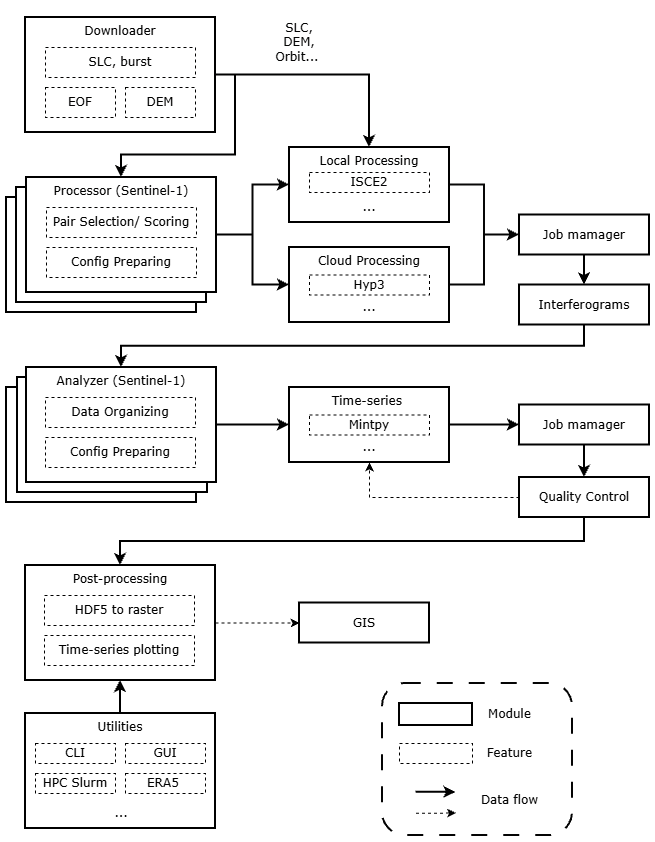
InSARHub is built around three loosely-coupled layers — Downloader, Processor, and Analyzer — each implemented as a registry of named backends. A shared insarhub_config.json written to the job folder accumulates configuration as the pipeline progresses, so every stage can be run independently or chained together.
- Downloader — searches ASF for scenes (full SLC or individual SLC-BURST granules), selects interferogram pairs with quality scoring, and fetches SLC data and orbit files.
- Processor — takes the selected pairs and produces (unwrapped) interferograms: cloud (HyP3), local ISCE2
stackSentinel, local GMTSARp2p_processing/p2p_S1_TOPS_Frame, or ISCE3/COMPASS burst geocoding. - Analyzer — inverts the interferogram stack into a displacement time series: MintPy
smallbaselineApp, GMTSAR's ownsbasbinary, or dolphin'stimeseries.
The Web UI and CLI are thin shells over the same Python API, so any workflow that runs in the browser can be reproduced exactly on the command line or in a script.
Pipeline Matrix
Each downloader feeds a set of compatible processors, and each processor a set of compatible analyzers. The registry wires these via compatible_downloader / compatible_processor; a workdir's saved insarhub_config.json records which pipeline it belongs to.
Downloader          Processor            Analyzer
─────────────────   ──────────────────   ─────────────────────────
S1_SLC           →  Hyp3_S1           →  Hyp3_Mintpy_SBAS
                 →  ISCE2_S1          →  ISCE2_Mintpy_SBAS
                 →  GMTSAR_S1         →  GMTSAR_Mintpy_SBAS
                                      →  GMTSAR_SBAS
S1_Burst         →  ISCE3_Burst       →  ISCE3_Dolphin_S1_PL
NISAR_GSLC       →  ISCE3_NISAR       →  ISCE3_Dolphin_NISAR_PL
Any local backend can run inside a container instead of on the host — see Container Execution for how --container works.